
There’s a courtyard at the back of almost every mid-size office building. Sometimes it’s a handful of concrete pavers with a few potted plants that someone watered enthusiastically in 2019 and then forgot about. Sometimes it’s a wide expanse of landscaping that looks beautiful from the conference room window and gets used approximately never.
The hospitality side isn’t much different. Hotels and mixed-use properties with underperforming exterior courtyards often treat them as visual amenities rather than functional ones. They photograph well. They don’t earn much.
That’s a missed opportunity, and, increasingly, it’s one that commercial property owners are starting to recognize.
The way people relate to where they work has shifted considerably over the past few years. Employees returning to the office aren’t just tolerating the commute; they’re comparing experiences. A research-backed study found that employees with access to natural light and outdoor views reported an 18% increase in productivity compared to those working in more enclosed environments. That’s not a trivial number when you’re trying to make the case for an in-person work culture.
The property value dimension is equally compelling. According to JLL research, offices located in lifestyle districts that offer access to amenities like outdoor pavilions can attract a 32% rental premium over comparable properties without those features. Not every building can relocate to a lifestyle district, but the broader principle is clear: Outdoor amenity space reads as value to tenants.
Before diving into solutions, it’s worth being honest about what underutilized outdoor space usually looks like in a commercial context. It’s not only an aesthetic problem but a functional one as well.
An outdoor courtyard that lacks shade coverage in South Florida becomes unusable for about eight months of the year. A rooftop terrace with no weather protection turns every afternoon thunderstorm into a three-day furniture-drying project. A hotel pool deck with beautiful hardscaping and zero shade structures is a liability waiting to happen during peak summer hours.
The issue isn’t that there’s not enough space. It’s that nothing has been done to make the space livable, which is different from making it look nice.
Any serious transformation of a commercial courtyard begins with overhead coverage. Without it, everything else is furniture arrangement.
The most common options in the commercial space range from shade sails and tensile structures to fixed pergolas and motorized louvered systems. Shade sails work at a modest scale but have meaningful limitations in wind-prone environments and require significant anchor infrastructure. Tensile canopies offer coverage with a more architectural presence, though they tend to work best in lower-wind environments than South Florida typically demands.
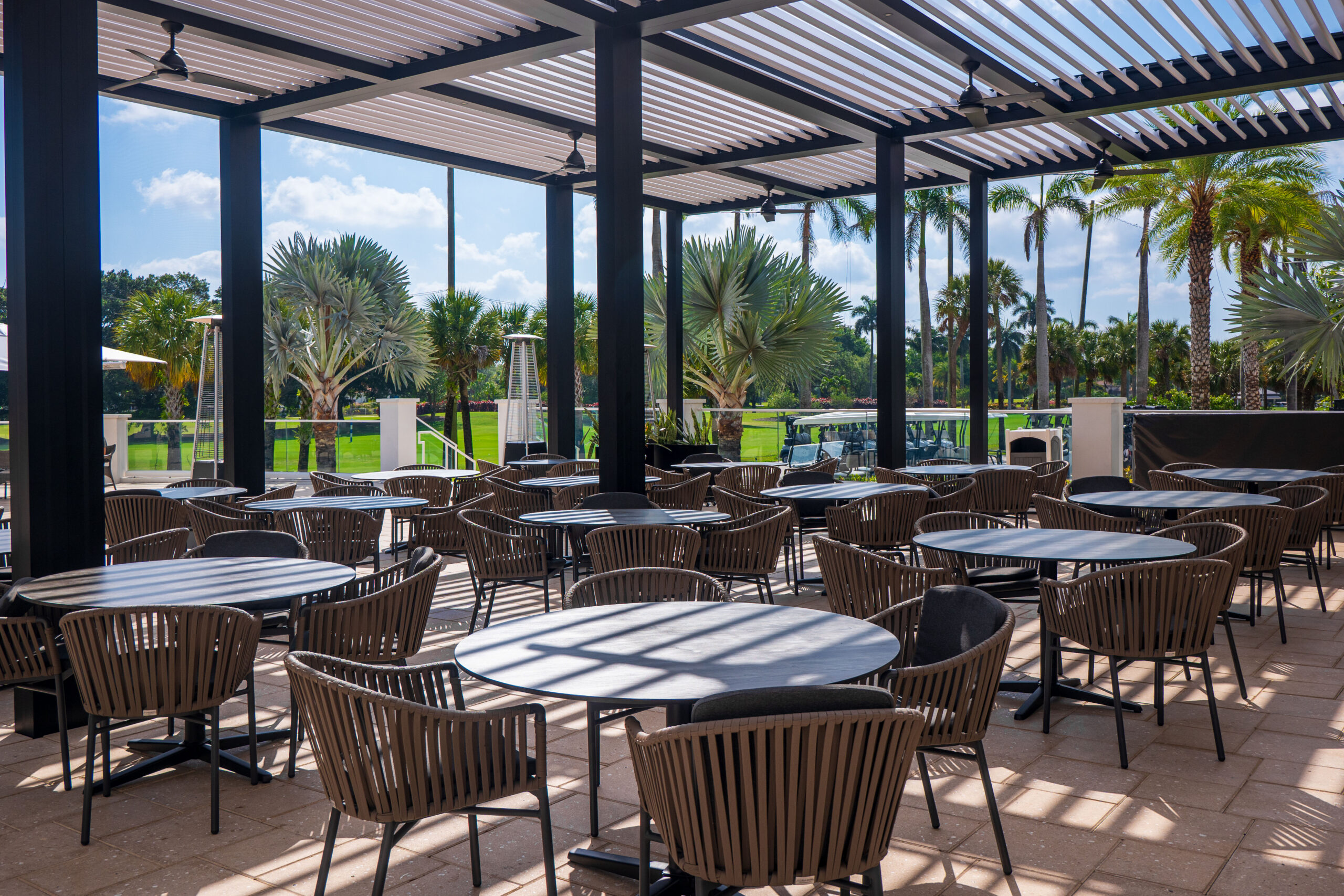
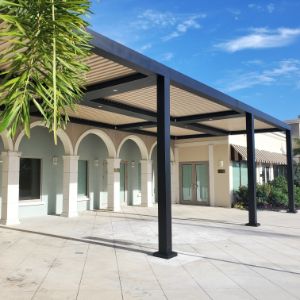
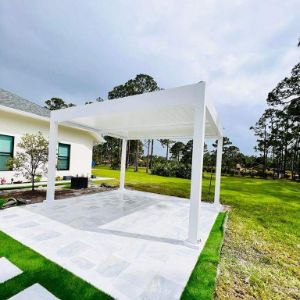
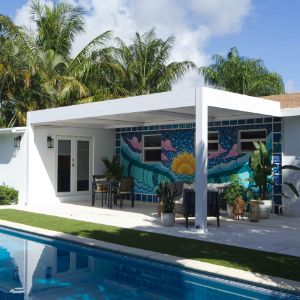
Fixed pergolas are a popular middle ground: lower cost than motorized systems, visually clean, and structurally reliable. For properties that want architectural definition without weather-responsive functionality, a fixed louvered pergola like the R-Breeze offers exactly that, with partial shade that creates a sense of enclosure without blocking air circulation entirely.
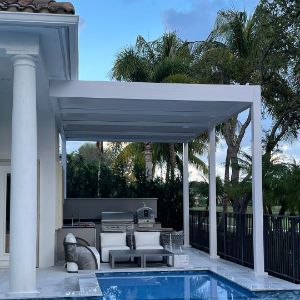
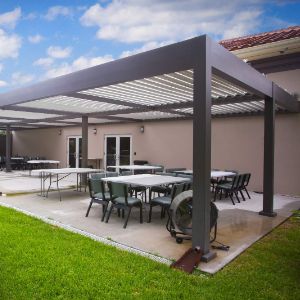
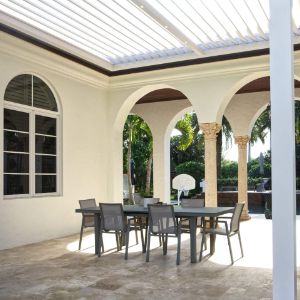
In hospitality environments and high-end corporate campuses, where year-round usability in variable weather is expected, motorized louvered systems perform at a different level. The ability to adjust shade coverage in real time, manage rainwater drainage through integrated gutters, and add-ons such as integrated lighting or privacy screens makes them closer to architecture than to furniture. SYZYGY Global’s R-Blade is designed specifically for this kind of application, with commercial-grade engineering built around concealed marine-grade stainless steel hardware, dual-walled gapless louvers, and high-grade aluminum that withstands the coastal Florida environment without ongoing structural maintenance concerns.
The right system depends heavily on the property’s needs, budget, and desired experience, and that’s where having the right team matters. What works beautifully on a boutique hotel rooftop isn’t necessarily the right call for a corporate office breakout area, and the distinctions aren’t always obvious until someone who’s done it before is walking the space with you.
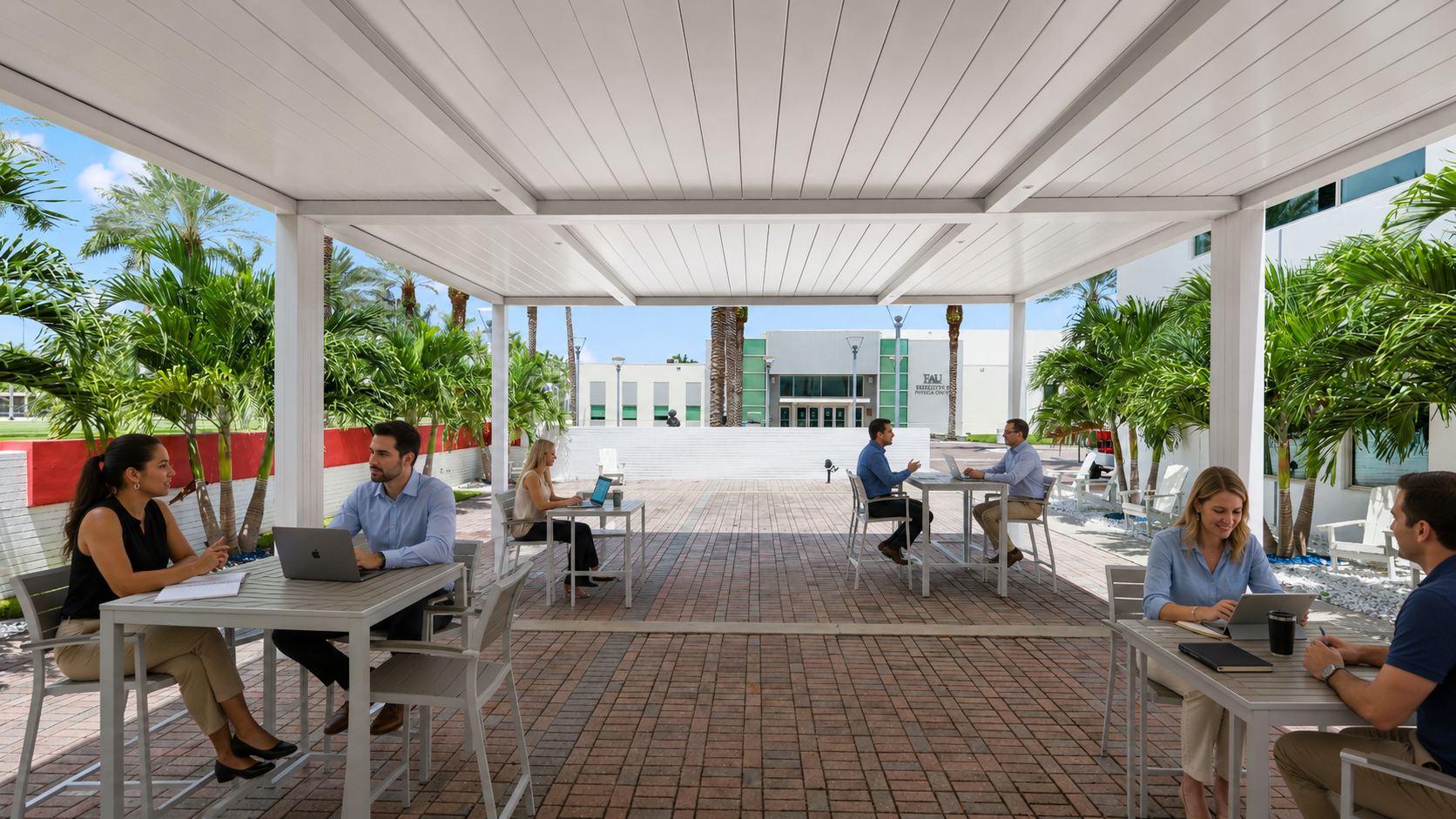
Overhead coverage gets a space to usable. What makes it genuinely functional comes down to a few additional considerations.
Seating that invites extended stays rather than brief pauses. Commercial-grade outdoor furniture has improved substantially in both durability and aesthetics. Investing in pieces that hold up to high traffic and UV exposure without constant replacement is worth the upfront cost.
Greenery and acoustic buffering. One of the persistent complaints about corporate outdoor spaces is that they don’t quite feel removed from the office, even when you’re physically outside. Thoughtful landscaping, living walls, or even tall planters can create enough visual and acoustic separation to shift the psychological experience of the space.
Power and connectivity. Outdoor work areas that lack power access get used once. Integrating discreet outlets and ensuring reliable Wi-Fi coverage extends the space’s utility significantly. Some commercial pergola systems incorporate integrated conduit routing within the frame, keeping wiring contained and clean.
Lighting for evening use. Office campuses with outdoor space that shuts down at dusk are leaving revenue and utility on the table. Warm integrated lighting changes the character of a space entirely after dark.
There’s a reason forward-thinking employers have started treating outdoor amenity space the way they treat lobby design. It signals something. An outdoor area that has clearly been invested in says the building is current, that leadership is paying attention to where people spend their time, and that the physical environment is part of the company’s value proposition.
For hospitality properties, the stakes are slightly different but no less real. An outdoor space that earns genuine positive reviews creates organic marketing. A forgettable one gets ignored in the write-up.
The courtyard you walk past every day might already be your best candidate for a renovation that pays for itself. SYZYGY Global’s commercial team works with property owners and developers across South Florida to design outdoor spaces that earn their square footage. Schedule a consultation to start the conversation.



























Name