

There’s a reason Florida patios go unused from June through September. It’s not a lack of beautiful outdoor space. It’s the heat: The thick, relentless kind that makes sitting outside for more than ten minutes an act of endurance rather than enjoyment.
But a lot of that discomfort is preventable. Outdoor temperature management isn’t just about aesthetics or ambiance. There’s actual science behind what keeps a patio livable in the middle of a South Florida summer, and understanding a few basic principles makes a real difference in how you design, equip, and use your outdoor space.
Direct solar radiation is the single largest contributor to outdoor thermal discomfort. When sunlight hits an unshaded surface—concrete, tile, even bare skin—it doesn’t just warm the air above it. It stores heat and radiates it back upward, turning your patio into something closer to an oven floor.
Architectural shade interrupts that cycle at the source. A 2023 study published in the International Journal of Environmental Research and Public Health found that shade was the single most effective intervention for reducing outdoor heat exposure, outperforming increased wind speed alone. Researchers found that blocking 90% of incoming solar radiation lowered measured heat stress temperatures by approximately 4 to 11 degrees Fahrenheit, depending on location, and that even partial shade at 50% coverage produced meaningful reductions. The geometry of shade matters, too. A solid roof overhead eliminates direct radiation, but it can also trap warm air if there’s no way for heat to escape.
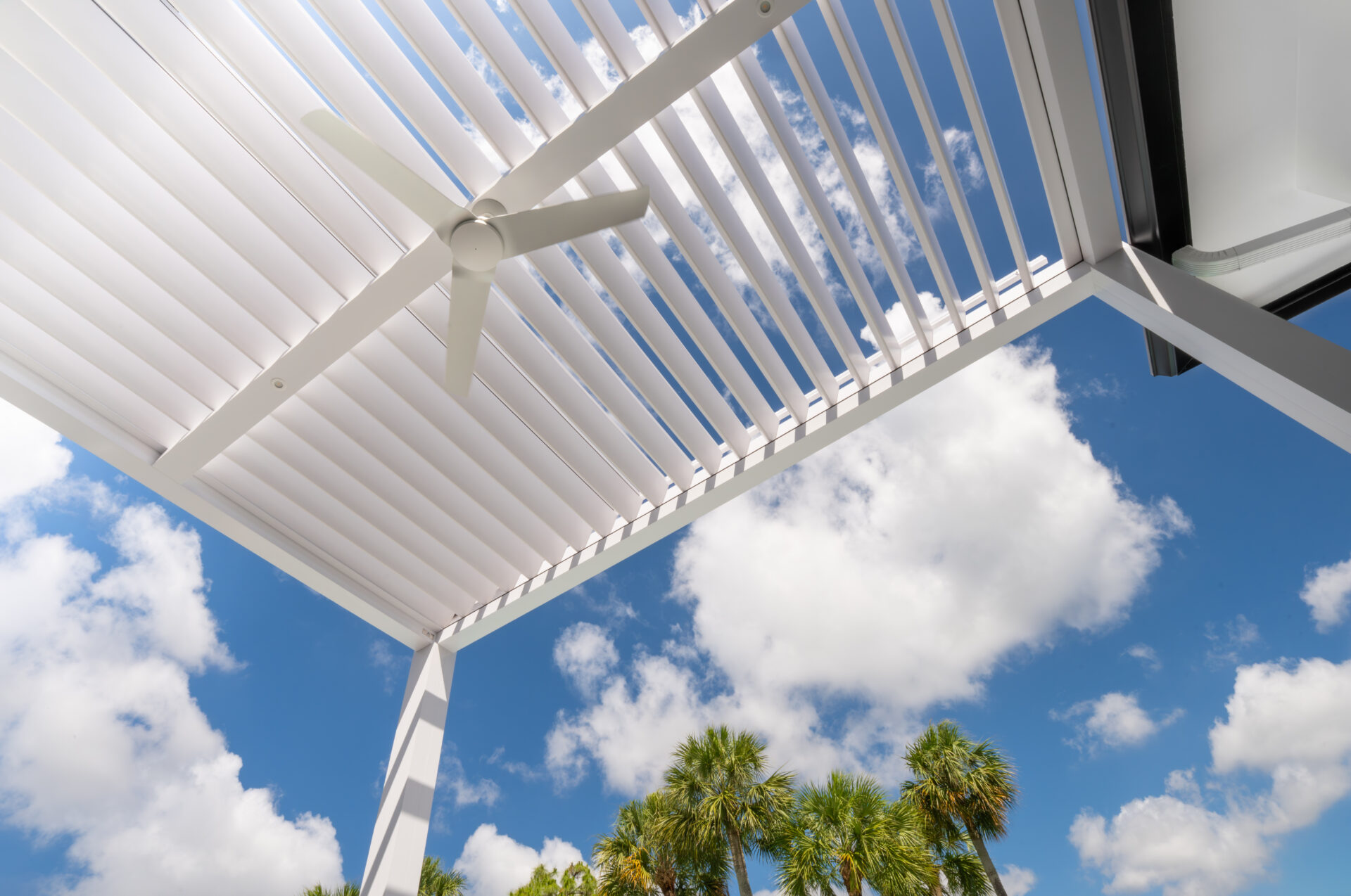
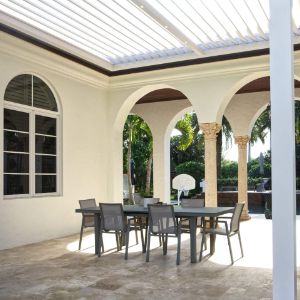
The best-performing shade structures aren’t sealed off — they’re designed to manage both sun and ventilation simultaneously. A louvered roof system, for instance, allows you to close down for full coverage during peak afternoon hours and open up to let hot air rise and move through as temperatures shift.
Moving air lowers how hot you register your environment, not the thermometer reading but the body’s experience of it. When air flows across skin, it accelerates moisture evaporation and draws heat away from the body’s surface. The ambient temperature stays the same. What changes is how much of that heat your body is actually holding onto.
In humidity-heavy climates like South Florida, where air moisture already slows the body’s natural cooling process, even modest airflow can create a meaningful shift in comfort. It’s not an illusion but a measurable physiological response to increased convective heat loss.
A 2022 study published in the Journal of Applied Meteorology and Climatology found that at coastal locations in the Florida Peninsula and Keys, heat index values now exceed danger thresholds on more than 20% of total summer days, a figure that has grown substantially since 2000. That context matters when designing an outdoor space, as you don’t plan for average conditions but rather for a climate that regularly hits what the National Weather Service classifies as “dangerous.”
Outdoor ceiling fans are one of the most effective tools for breaking heat stagnation under a covered patio. The key is proper sizing for the footprint and adequate clearance so airflow reaches living height. Installing fans at the wrong height or spacing them too far apart creates dead zones where air barely moves. When a covered structure has well-placed fans running, the perceived temperature under it drops noticeably, enough to turn an uncomfortable space into one you actually want to stay in.
Cross-ventilation matters just as much. A patio structure positioned to catch prevailing breezes, or designed with open sides to allow air movement through, performs far better thermally than one that encloses too tightly.
Misting systems work through flash evaporation. A fine mist of water is released into the surrounding air, the droplets absorb ambient heat as they evaporate, and the result is cooler air without leaving surfaces or people noticeably wet, as long as the system is properly designed. A peer-reviewed study from Arizona State University, published in the International Journal of Biometeorology, found that misting meaningfully improved outdoor thermal comfort across all tested conditions and that misting combined with shade produced the greatest reduction of any single approach.
In humid conditions like South Florida, where moisture-saturated air slows evaporation, the cooling effect is real but more modest than what the same system delivers in a drier climate. A misting system here won’t replicate desert-grade temperature drops, but paired with shade and moving air, it meaningfully shifts the comfort threshold on days when the heat index is already pushing past uncomfortable.
The difference between a misting system that works and one that just makes everything damp is pressure. Low-pressure systems produce larger droplets that don’t evaporate before landing. High-pressure systems, typically 1,000 PSI and above, generate a mist fine enough to flash-evaporate almost instantly, delivering the cooling effect without the wet furniture.
Integration matters too: misting lines routed along the perimeter of a covered structure, rather than installed as a freestanding kit, look intentional rather than improvised and perform more evenly across the space. And as the ASU research confirms, a misting system operating beneath an already-shaded structure isn’t just more comfortable; it’s doing measurably more work than one running in direct afternoon sun.
The patios that stay genuinely comfortable through a Florida summer don’t rely on a single solution. They’re layered: shade overhead to block radiation, ceiling fans to keep air in motion, a misting system for the hottest hours, and thoughtful material choices at the surface level (light-colored pavers, for example, absorb significantly less heat than dark stone).
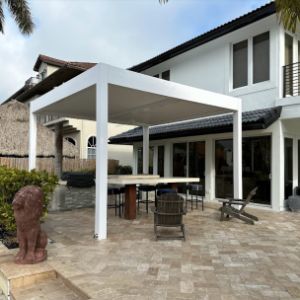
That layering approach also shapes how people invest in outdoor spaces. A covered structure anchors everything; it’s the foundation that makes fans, misting, and furniture worth placing. Without it, you’re cooling open air. With it, you’re creating a defined, manageable environment that actually responds to what you add to it.
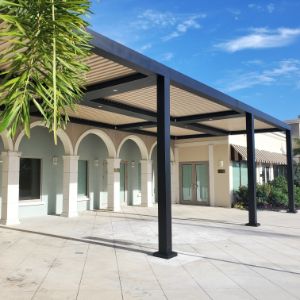
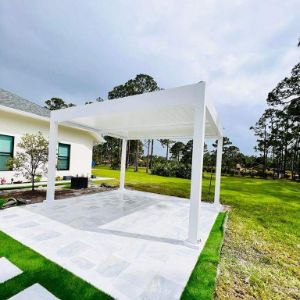
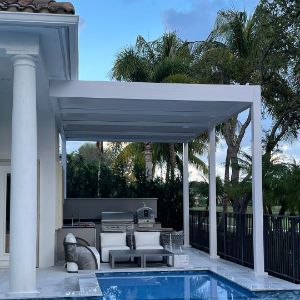
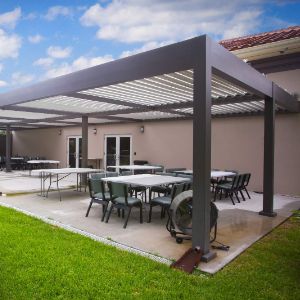
Motorized louvered pergola systems, in particular, give homeowners precise control over that environment. The ability to close louvers against afternoon sun, then open them in the evening to let warm air escape and cooler air in, means the structure itself is doing thermal work rather than just providing static shade. You can explore how these systems come together in projects across South Florida in our residential gallery.
If you’re also thinking about surface-level maintenance in a coastal environment—the kind that keeps your outdoor investment looking the way it should year after year—our Salt Spray Survival Guide is worth reading alongside this one.
The Bigger Picture

According to data from NOAA’s National Centers for Environmental Information, average maximum summertime temperatures across Palm Beach, Broward, Miami-Dade, and Monroe counties have been rising at a rate of 0.29°F per decade over the last 50 years. The heat South Florida homeowners are managing today is measurably more intense than the heat of a generation ago, and that trajectory isn’t reversing.
Designing for outdoor comfort isn’t a luxury add-on anymore. It’s an investment in how much of your own property you can actually use and for how many months of the year.
Ready to design an outdoor space that performs as well in July as it does in January? Schedule a design consultation with the SYZYGY Global team.





























Name