

Living in coastal Florida is a study in contrasts. Sunlit mornings, salt air, open skies—and a storm season that demands serious preparation. When investing in an outdoor structure, the question isn’t whether it should be hurricane-rated. It’s whether the product you’re choosing has been site-specific engineered with the precision required to protect your home, your lifestyle, and your long-term investment.
A hurricane-rated pergola brings together refined outdoor living and site-specific engineering, purpose-built for South Florida’s most demanding conditions. From wind loads to materials to structural detailing, this is what storm-ready design looks like when performance and aesthetics are held to the same uncompromising standard.
In coastal Florida, the term hurricane-rated carries real weight. It reflects measurable engineering standards, verified testing, and strict building code compliance designed for extreme weather conditions.
A hurricane-rated pergola is engineered to withstand specific wind loads—up to 175 mph, depending on the governing municipality’s code requirements and the installation site. Structural calculations, material performance, and anchoring systems all work together to meet or exceed local code requirements. The result is a structure designed to perform under pressure, not just appear strong.
Clarity matters when discussing storm protection. Hurricane-rated does not mean hurricane-proof. No outdoor structure can guarantee total protection in every storm scenario. Instead, hurricane-rated design applies rigorous, site-specific standards to deliver the highest level of protection realistically achievable.
South Florida enforces some of the most demanding building codes in the country. Requirements such as Miami-Dade County’s coastal regulations exist to reduce risk and protect property. Meeting these standards requires thoughtful design, advanced engineering, and precision at every stage.
An outdoor structure is more than an addition. It’s an extension of your home and a reflection of how you live in it. In coastal Florida, a pergola that is not properly engineered risks more than cosmetic damage. Poorly designed structures can fail under storm pressure, creating costly repairs, property damage, and unnecessary stress when conditions are already challenging.
Hurricane-rated construction protects your investment through verified engineering, durable materials, and installation methods designed for coastal realities. It is the difference between replacement and resilience.
In South Florida, performance is not optional. Building departments and insurance providers often require permanent outdoor structures to meet defined wind load standards, particularly in coastal zones. Miami-Dade, Palm Beach, and Broward counties all enforce strict permitting and inspection requirements for pergolas and similar structures.
Non-compliant installations can lead to failed inspections, permit delays, coverage exclusions, or denied claims. A hurricane-rated pergola streamlines the approval process and helps ensure your structure is recognized as a protected asset rather than a liability.
There is a certain peace of mind that comes from knowing your outdoor space was designed with intention. When storms approach, a hurricane-rated pergola lets you focus on preparation, safety, and the people who matter most.
That confidence is not accidental. It is engineered.

Hurricane-rated pergolas begin with engineering, not ornamentation. Every component is designed to manage wind forces in a controlled, intentional way, reducing stress and improving overall stability during severe weather events.
This includes load distribution systems that transfer wind forces throughout the structure rather than concentrating them at vulnerable points. Connection areas are reinforced with precision detailing, recognizing that joints and intersections are where failure most often occurs. Secure foundation and anchoring systems are engineered to resist uplift, while frame geometry is optimized to balance strength, proportion, and wind resistance.
The result is a structure that behaves as a unified system under pressure, not a collection of individual parts.
Material choice plays a critical role in storm performance, especially in coastal environments. SYZYGY Global’s hurricane-rated pergolas are built using high-grade aluminum, selected for its strength, dimensional stability, and resistance to moisture-related degradation. Unlike wood, aluminum does not swell, rot, or weaken when exposed to prolonged humidity and heavy rain.
Connection points are secured with concealed marine-grade stainless steel hardware, chosen specifically for its corrosion resistance in salt-air environments. These components preserve both structural integrity and visual refinement over time.
In motorized systems, dual-walled gapless louvers contribute to both weather management and structural performance. Their engineered profile helps manage wind forces while maintaining smooth operation and a clean architectural appearance.
Hurricane-rated performance depends on precision. Advanced manufacturing techniques ensure tight tolerances, consistent quality, and repeatable performance across every component. Computer-aided design and engineering guide each project, allowing for site-specific customization without compromising structural integrity.
Quality control at every stage of production helps eliminate weak points before installation begins. The result is a pergola that reflects intentional design, disciplined engineering, and confidence in every detail.
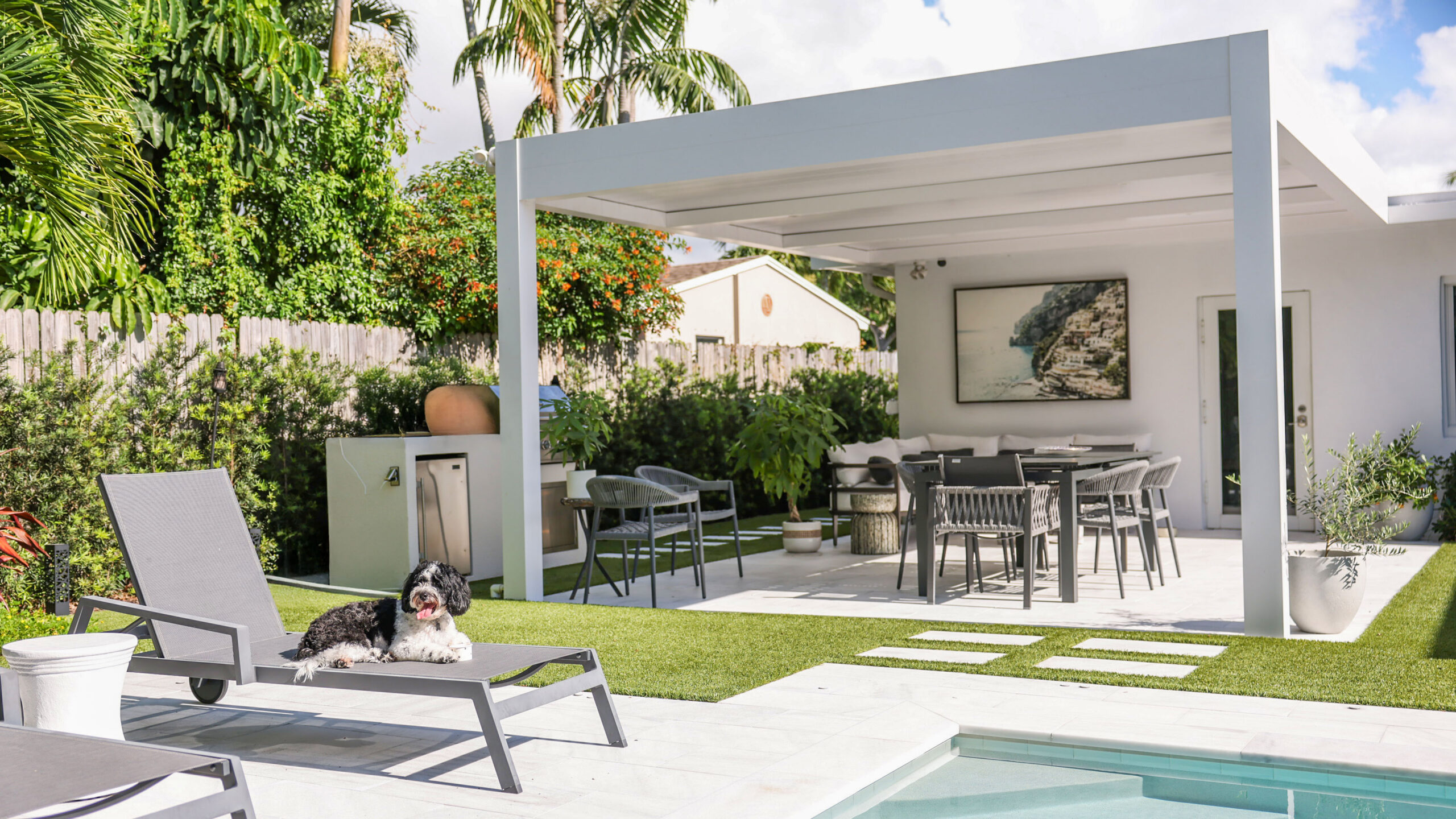
South Florida presents unique environmental demands, and hurricane-rated performance requires more than a one-size-fits-all solution. SYZYGY Global’s pergolas are designed specifically for coastal conditions, where salt air, intense sun, heavy rainfall, and high winds intersect year-round.
Corrosion resistance is built into every detail, from marine-grade materials to the highest-quality European powder coating, protecting both structure and finish over time. SYZYGY Global specializes in hurricane-rated and Miami-Dade county-approved pergolas, creating outdoor spaces that balance refined design with the confidence that comes from having received NOA certification in one of the nation’s most rigorous building code regions for hurricane-prone areas.
Integrated water management is equally intentional. Fully extruded integrated gutters are designed to handle rainfall efficiently, directing water away from the structure without disrupting clean architectural lines. UV exposure is addressed through materials and finishes selected to maintain both structural integrity and visual clarity despite constant sun exposure.
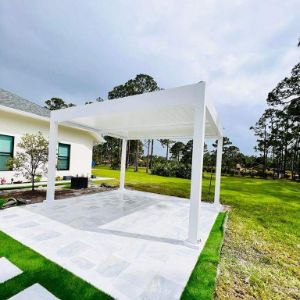
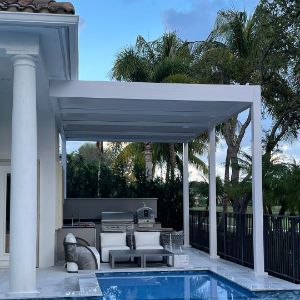
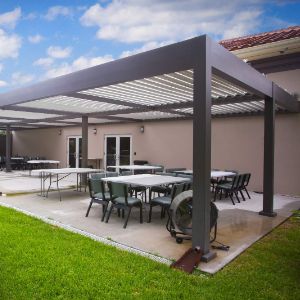
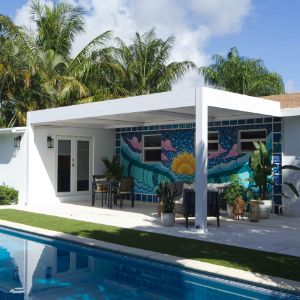
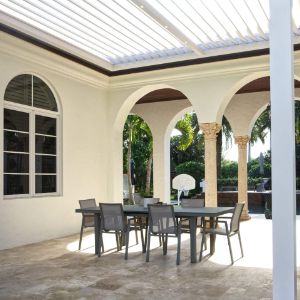
Engineering is only meaningful if it performs where it matters most. SYZYGY Global’s hurricane-rated pergolas have been installed throughout South Florida’s coastal communities, where they have weathered real storms and demanding environmental conditions.
These installations are not theoretical exercises. They are lived-in spaces that continue to perform season after season, offering quiet proof of durability, precision, and thoughtful design. It is this consistency—across neighborhoods, properties, and years—that defines true hurricane-rated performance.
Hurricane-rated pergolas are designed to require minimal preparation, but a few intentional steps help ensure optimal performance when storms approach.
Motorized louvers should be positioned in the fully open setting to reduce wind uplift and support proper water management. Any loose accessories, furnishings, or decorative elements beneath the structure should be secured or removed. A brief visual inspection before storm season allows small maintenance items to be addressed proactively, rather than under pressure.
These simple measures support the pergola’s engineered performance without adding unnecessary complexity.
Once severe weather arrives, your pergola’s structure, anchoring, and materials are engineered to work together as a cohesive system, managing wind and rain while maintaining stability.
This is not a moment for adjustment or intervention. The design does the work, allowing you to focus on what matters most—safety, preparedness, and peace of mind.
When conditions are clear, a visual inspection helps confirm continued performance. Check for any debris impact, confirm motorized systems are operating smoothly, and rinse surfaces to remove salt residue that can accumulate after heavy weather.
SYZYGY Global provides comprehensive manufacturer’s warranty coverage and responsive support should any storm-related concerns arise. Care does not end at installation. It continues through every season.
When viewed side by side, the distinction between hurricane-rated and standard pergolas becomes clear. The difference is not cosmetic. It is structural, intentional, and long-term.
| Feature | Hurricane-Rated Pergola | Standard Pergola |
| Wind Resistance | Engineered for site-specific wind loads up to 175 mph, depending on the governing municipality’s code requirements, in coastal zones | Typically designed for moderate, not tropical conditions |
| Materials | High-grade aluminum with marine-grade stainless steel hardware | Commonly wood or standard aluminum components |
| Anchoring Systems | Reinforced foundations designed to resist uplift and lateral forces | Basic footings with limited wind resistance |
| Code Compliance | Meets Miami-Dade and local municipal requirements | May not satisfy coastal permitting standards |
| Insurance Recognition | Typically categorized as a permitted structure | Coverage may be limited or excluded |
| Longevity | Designed for decades of coastal exposure | Increased maintenance and earlier replacement |
The cost difference between hurricane-rated and standard construction is often modest when viewed at the time of installation. Over the life of the structure, however, the value becomes unmistakable. Resilience reduces repair, replacement, and uncertainty—especially in a region where storms are not a possibility but a reality.

South Florida’s building codes are among the most rigorous in the country, shaped by decades of experience with severe weather. These regulations are not obstacles. They are safeguards designed to protect homes, property, and the people who live within them.
In Miami-Dade County, permanent outdoor structures must comply with the county’s stringent building codes, which include wind load ratings up to 175 mph, depending on the municipality’s requirements, in many coastal areas. These standards demand site-specific engineering and documented performance.
Palm Beach County enforces coastal construction regulations that address wind exposure, anchoring methods, and structural detailing for pergolas and similar installations. Permitting is precise, and compliance is closely reviewed.
Broward County requires engineered drawings, wind load calculations, and verified installation methods to ensure structural integrity under hurricane conditions.
Navigating these requirements takes experience and coordination. SYZYGY Global manages the full permitting and compliance process, from engineering documentation to final inspection. Every pergola is designed, reviewed, and installed to meet local code requirements without burdening the homeowner.
Choosing a hurricane-rated pergola is an investment in both lifestyle and longevity. Choosing who designs and builds it matters just as much.
SYZYGY Global brings together site-specific engineering, refined design, and precision manufacturing to create outdoor structures that perform as beautifully as they look. Every pergola is thoughtfully designed for its environment, its architecture, and its intended use—no templates, no shortcuts.
Our work has been recognized with more than 20 industry awards, including 9 PRISM Awards in 2024 and 15 in 2025, reflecting a consistent commitment to quality, innovation, and execution. Just as important is our local expertise. Since 2017, we have designed and installed pergolas throughout South Florida, with a deep understanding of regional codes, coastal conditions, and architectural expectations.
Founded by Jason Herring and Julie Hawbaker, SYZYGY Global is built on the belief that performance and aesthetics should never be separated. Our installations throughout Delray Beach, Boca Raton, Palm Beach, Fort Lauderdale, and Miami stand as lasting examples of that philosophy.
From engineering and permitting to installation and long-term support, we remain a partner throughout the life of your outdoor space because storm-ready design should feel effortless—and enduring.
Can a pergola withstand a Category 5 hurricane?
Hurricane-rated pergolas are engineered to meet site-specific wind load requirements, up to 175 mph, depending on municipality code requirements, in South Florida’s coastal zones. While no outdoor structure can guarantee survival in every storm scenario, proper engineering significantly increases performance and resilience compared to non-rated structures.
How is a hurricane-rated pergola installed differently?
Installation is guided by engineering, not approximation. Hurricane-rated pergolas require reinforced foundations, site-specific anchoring systems, and precision assembly that follows engineered drawings. Each connection point is treated as a critical structural component, with inspections built into the process.
Do motorized louvers need to be removed before a storm?
No. Motorized louver systems are designed to remain in place. Louvers should be positioned in the recommended open setting, where their dual-walled construction and secure mounting help mitigate uplift without motor removal.
What is the difference between hurricane-rated and hurricane-proof?
Hurricane-rated refers to a structure that meets defined wind load standards and building code requirements through verified engineering. Hurricane-proof implies absolute protection under all conditions, which no outdoor structure can promise. Hurricane-rated design delivers highest standard, site-specific engineering.
Will homeowners’ insurance cover a hurricane-rated pergola?
Most insurance policies recognize properly permitted, hurricane-rated pergolas as insurable structures, particularly in coastal zones. Coverage varies by provider, so confirmation is always recommended. Non-rated or unpermitted structures may face additional exclusions or limitations.
A hurricane-rated pergola is not just about weathering storms. It is about creating an outdoor space that feels secure, intentional, and enduring, season after season.
With refined design, site-specific engineering, and proven performance across South Florida’s coastal communities, SYZYGY Global pergolas are built to protect what matters while elevating how you live outdoors.
When storms come, confidence should already be in place. Ready to invest in storm-resistant outdoor living?
Schedule a complimentary design consultation today and discover why South Florida homeowners choose SYZYGY Global for hurricane-rated pergolas engineered to last.
Disclaimer: Hurricane-rating only applies to the R-Blade motorized louvered pergola. Miami-Dade County, Florida NOA No. 25-0205.04 – Expiration March 20, 2030

























Name