
Choosing between an aluminum vs wood pergola is one of the most consequential decisions in any outdoor living project. The material you choose influences not only how your space looks, but how it performs over time, especially in South Florida’s demanding coastal climate.
Wood pergolas are often admired for their traditional character and natural warmth. Aluminum pergolas, on the other hand, are engineered for longevity, structural consistency, and minimal upkeep. When climate, maintenance, and long-term value are part of the equation, the differences between these two materials become far more than aesthetic.
Below, we break down aluminum vs wood pergolas across design, durability, maintenance, and performance so you can make a confident, informed decision for your South Florida home.
Wood pergolas are often chosen for their familiar charm and organic presence. The material brings warmth, texture, and natural variation that many homeowners associate with timeless outdoor design.
From visible grain patterns to subtle tonal shifts, wood offers an authenticity that feels rooted in tradition. It can also be shaped and detailed with relative ease, allowing for decorative brackets, curved beams, and ornamental accents that suit classic architectural styles.
Wood is also highly receptive to finishes. Stains range from light, natural hues to rich, dramatic tones, giving homeowners flexibility in how the structure complements surrounding materials.
One of wood’s primary advantages is its lower upfront cost. Basic wood pergolas typically come in at a lower initial investment than premium aluminum systems, which can be appealing for budget-sensitive projects.
In some cases, experienced DIY builders may attempt a simple wood pergola to further reduce costs. In South Florida, however, this approach carries added risk due to wind loads, moisture exposure, and hurricane requirements.
Wood pergolas pair naturally with traditional, craftsman, and rustic homes. They integrate seamlessly into garden settings, creating a softer visual transition between landscaping and architecture. For homeowners prioritizing a classic aesthetic over long-term performance, this familiarity is often the deciding factor.
While wood pergolas offer rustic visual appeal, South Florida’s climate introduces ongoing challenges that directly impact performance, longevity, and ownership costs.
Wood pergolas require consistent, hands-on upkeep to remain structurally sound and visually appealing in a humid, subtropical environment. Typical annual maintenance includes:
For most homeowners, this translates to 16–24 hours of maintenance each year or additional out-of-pocket costs to hire a professional.
South Florida’s year-round humidity, frequent rain, and intense sun place constant stress on wood structures.
High moisture levels cause wood to absorb and release water repeatedly, leading to accelerated warping, cracking, and rot. Mold and mildew growth are also common without vigilant maintenance.
Termites present an additional risk. Subterranean termites are prevalent throughout the region, and even pressure-treated lumber remains vulnerable over time. Left undetected, termite damage can compromise structural integrity within a decade.
Prolonged UV exposure further degrades wood fibers, resulting in fading, surface checking, splintering, and gradual strength loss. For coastal properties, salt air compounds these issues by drawing moisture into the wood and accelerating deterioration, often shortening the pergola’s usable lifespan.
Even with diligent care, wood pergolas have a limited lifespan in South Florida’s climate. Heat, humidity, UV exposure, and pests steadily wear down the material over time.
With excellent maintenance, typical lifespan expectations are:
In practice, many wood pergolas in South Florida begin showing noticeable deterioration closer to the 5-year mark. At that point, homeowners often face substantial repairs, partial rebuilds, or full replacement to maintain safety and appearance.
Wood pergolas can be engineered to meet hurricane load requirements when properly designed and installed. However, long-term performance depends heavily on material condition and ongoing maintenance.
Connection points are particularly critical, as fasteners and joints experience the highest stress during high-wind events. Over time, moisture exposure and UV degradation can reduce wood’s structural strength, making older pergolas more vulnerable than when they were first installed.
Because of these variables, wood pergolas require regular inspections to confirm that connections remain secure and that no hidden deterioration has compromised performance. After major storms, repairs are common, especially when flying debris causes impact damage.
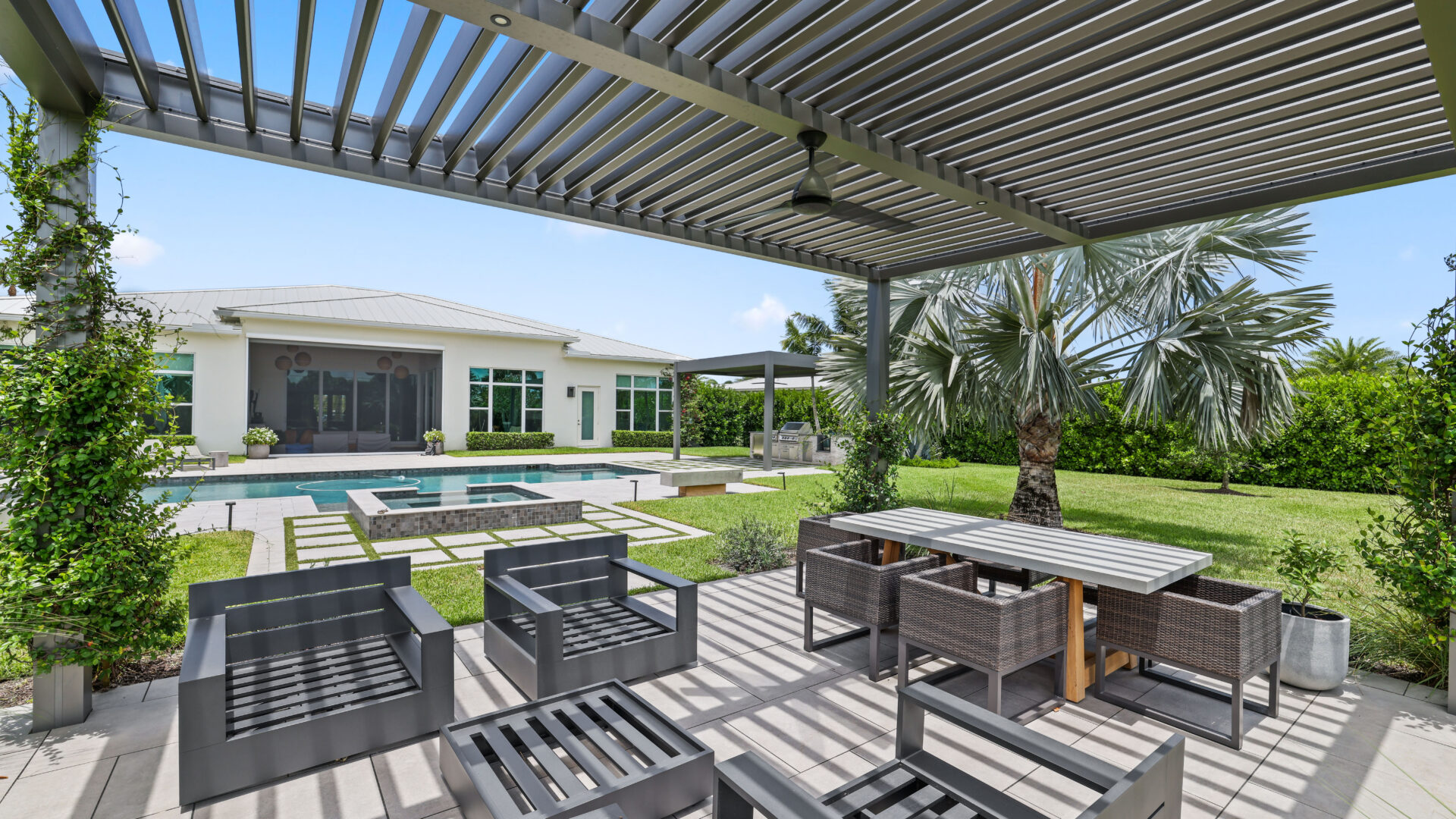
One of the defining advantages in the aluminum vs wood pergola comparison is maintenance. High-quality aluminum pergolas are engineered to be truly hands-off, eliminating the recurring upkeep that comes with organic materials.
When treated with the highest-quality European powder coating and non-porous surfaces, aluminum pergolas require little more than an occasional rinse to remove surface debris. There is no need for staining, sealing, painting, or structural touch-ups, and no concern for rot, mildew, or insect damage.
Over time, this translates into a markedly different ownership experience. Aluminum pergolas preserve their appearance and performance without ongoing intervention, allowing homeowners to enjoy their outdoor space rather than maintain it.
Aluminum pergolas are purpose-built for demanding environments, including South Florida’s coastal and high-humidity conditions. Constructed from high-grade aluminum, these structures are inherently resistant to corrosion, oxidation, and material fatigue caused by salt air exposure.
Unlike wood, aluminum does not absorb moisture. It remains dimensionally stable, meaning it will not warp, crack, split, or swell with changing weather conditions. The powder-coated finish is UV-stabilized, ensuring consistent color and surface integrity even under prolonged sun exposure.
Aluminum is also entirely immune to biological threats. Termites, mold, mildew, and decay simply do not affect the material, allowing the structure to maintain its strength and visual clarity year after year.
A defining advantage in the aluminum vs wood pergola discussion is lifespan. Premium aluminum pergolas are engineered for decades of reliable performance, maintaining both structural integrity and visual refinement over time.
Because aluminum does not degrade due to moisture, pests, or UV exposure, its performance remains consistent year after year. The structure you install today is designed to function and look the same far into the future, without the gradual decline common to organic materials.
This durability creates long-term value that extends beyond maintenance considerations. Aluminum pergolas do not require periodic rebuilding, material replacement, or aesthetic restoration to remain usable and safe. Instead, they deliver a stable, predictable ownership experience that aligns with the expectations of a permanent outdoor living investment.
Just as important, aluminum provides peace of mind. Unlike wood structures that require ongoing inspections to monitor for hidden deterioration, aluminum maintains its strength without the need for continual structural vigilance.
For homeowners planning to enjoy their pergola for decades rather than years, aluminum offers a level of permanence that wood simply cannot match in South Florida’s climate.
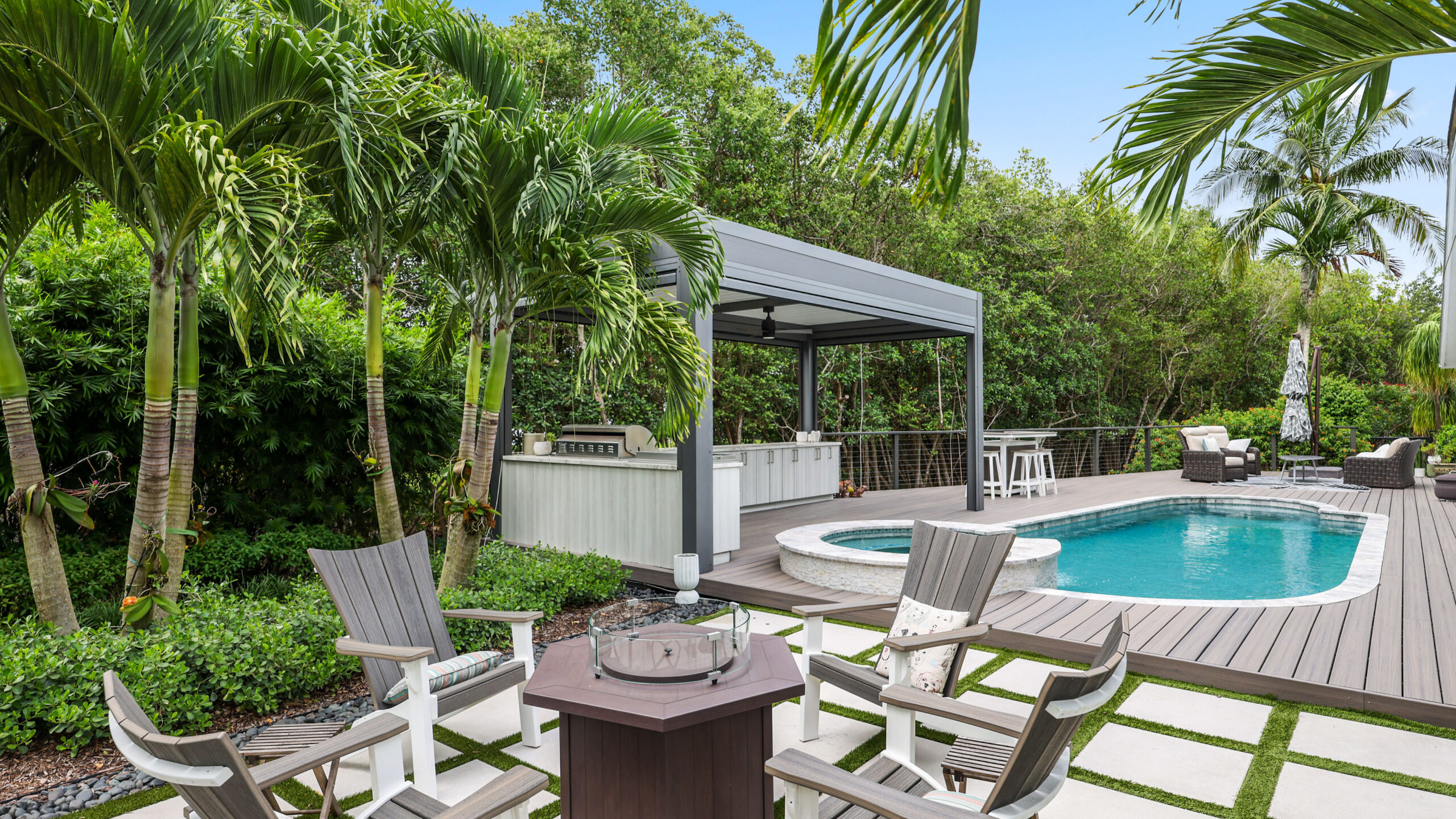
In South Florida, outdoor structures must be designed for more than everyday weather. SYZYGY Global’s aluminum pergolas are Miami-Dade county approved and NOA certified, delivering dependable performance during extreme wind events.
Unlike wood structures that can weaken over time, aluminum maintains consistent material strength throughout its lifespan. Engineered connections distribute loads evenly, while concealed marine-grade stainless steel hardware provides secure attachment without exposing vulnerable fasteners to the elements.
Because aluminum does not absorb moisture or degrade structurally, its performance remains predictable year after year. This consistency is critical during hurricanes, when structural reliability matters most.
After major storms, aluminum pergolas stand out as the superior material, retaining their alignment, integrity, and appearance, eliminating the need for post-storm repairs or reinforcement that is common with wood structures.
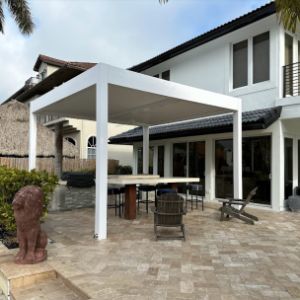
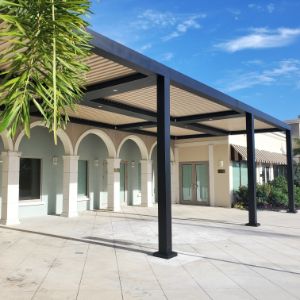
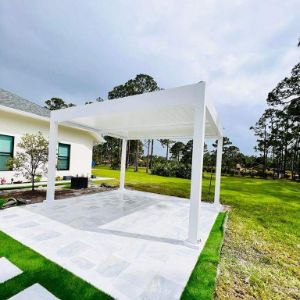
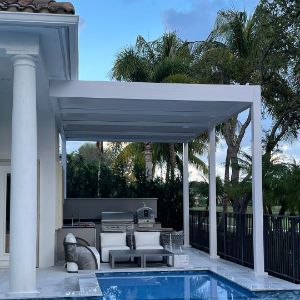
Aluminum pergolas bring a refined, contemporary sensibility to outdoor spaces. Clean lines, balanced proportions, and precise engineering create a structure that feels intentional rather than ornamental.
Because aluminum remains perfectly straight and dimensionally stable, beams and posts maintain crisp alignment over time. Concealed marine-grade stainless steel hardware reinforces this seamless appearance, allowing the structure itself to take visual precedence without distraction.
Finish quality plays a significant role in aluminum’s design versatility. The highest-quality European powder coating delivers consistent color, smooth texture, and long-term resistance to fading. From subtle neutrals to bold architectural tones, aluminum pergolas can be tailored to complement a wide range of exterior palettes.
For homeowners drawn to the warmth of wood, advanced aluminum woodgrain finishes offer the visual character of natural materials without the maintenance challenges. The result is a pergola that integrates effortlessly with contemporary, transitional, and thoughtfully designed traditional homes.
Aluminum pergolas unlock design and functionality that simply are not achievable with wood. One of the most significant differentiators in the aluminum vs wood pergola comparison is the ability to integrate motorized louvered roof systems.
These adjustable louvers allow homeowners to transition seamlessly from open sunlight to complete shade and weather protection. When closed, dual-walled gapless louvers form a watertight surface that manages rain efficiently while maintaining a clean architectural profile. Control options are intuitive and discreet, designed to adapt effortlessly to daily use and changing conditions.
Because aluminum structures are engineered with precision, they accommodate concealed wiring and integrated technology without compromising aesthetics. Lighting, climate elements, and entertainment features are incorporated directly into the structure, maintaining visual clarity while enhancing comfort and usability.
Smart sensors and automation further elevate the experience, allowing the pergola to respond intelligently to weather conditions and user preferences. The result is an outdoor environment that feels responsive, refined, and thoughtfully designed.
SYZYGY Global’s aluminum pergolas are custom-engineered for each site, ensuring exact measurements, balanced proportions, and a flawless fit. This level of precision enables design possibilities that are structurally impractical with wood, while also delivering predictable outcomes throughout the design and installation process.
The end result is a pergola that feels intentional, composed, and fully integrated into the home’s architecture.

| Consideration | Aluminum Pergola | Wood Pergola |
| Ongoing Maintenance | Minimal, occasional rinsing | Requires regular upkeep |
| Structural Consistency | Remains stable over time | Degrades with age and exposure |
| Expected Longevity (South Florida) | Designed for decades of use | Limited by climate conditions |
| Hurricane Performance | Hurricane-rated engineering | Can weaken over time |
| Moisture & Humidity Response | Non-porous and unaffected | Absorbs moisture, prone to rot |
| Termite Resistance | Completely immune | Vulnerable |
| Coastal Salt Air Exposure | Engineered for marine environments | Accelerates deterioration |
| UV Exposure | Powder coating resists UV damage | Causes fading and fiber breakdown |
| Design Precision | Clean lines and consistent geometry | Natural variation over time |
| Motorized Louver Compatibility | Fully integrated systems | Not compatible |
| Smart Home Integration | Seamless and concealed | Limited |
| Long-Term Appearance | Maintains refined finish | Requires restoration |
| Material Sustainability | Recyclable with no treatments | Requires chemical treatments |
South Florida places year-round environmental stress on outdoor structures. Heat, humidity, salt air, and severe weather are not occasional events here. They are constants. When comparing an aluminum vs wood pergola in this region, climate performance becomes a deciding factor rather than a secondary consideration.
High humidity creates ongoing moisture exposure that affects organic materials at a structural level. Wood repeatedly absorbs and releases moisture, leading to warping, surface cracking, and biological growth over time. Aluminum, by contrast, is non-porous and dimensionally stable. It does not absorb moisture, support mold growth, or require protective treatments to maintain performance.
Prolonged UV exposure accelerates material degradation. In wood, UV radiation breaks down fibers, causing fading, surface checking, and gradual strength loss. Aluminum pergolas are finished with UV-stabilized, highest-quality European powder coating, ensuring color and surface integrity remain consistent even under constant sun exposure.
Salt air introduces additional challenges for materials used near the coast. Wood draws in moisture more readily in salty environments, accelerating deterioration and stressing fasteners and connections. Aluminum pergolas, constructed from high-grade aluminum and secured with concealed marine-grade stainless steel hardware, are engineered specifically for marine and coastal conditions.
South Florida structures must perform reliably under extreme wind loads. While wood pergolas can meet engineering requirements when new, their performance can diminish as the material ages and absorbs moisture. Aluminum maintains consistent structural properties over time, allowing hurricane-rated designs to perform predictably without degradation.
Termites are a persistent concern throughout South Florida. Even treated wood remains vulnerable, often requiring preventative measures and ongoing inspections. Aluminum pergolas eliminate this risk entirely. The material cannot be compromised by insects, decay, or biological activity.
The right pergola material depends on how you plan to use your outdoor space and what you expect from it over time. When evaluating an aluminum vs wood pergola, the decision often comes down to priorities around maintenance, longevity, and performance in South Florida’s climate.
A wood pergola may be the right fit if:
An aluminum pergola may be the better choice if:
If you want the best of both worlds, choose powder-coated aluminum wood grain.
For South Florida properties, particularly in coastal and high-humidity environments, aluminum pergolas consistently outperform wood. The material’s resistance to moisture, pests, UV exposure, and severe weather makes it uniquely suited to the realities of this region.
While wood pergolas may offer initial visual appeal, their performance is heavily influenced by climate conditions and ongoing maintenance. Over time, exposure to humidity, salt air, and intense sun often compromises both appearance and structural reliability.
Aluminum pergolas are engineered with these conditions in mind. Their stability, hurricane-rated construction, and enduring finish allow them to maintain both form and function year after year. For homeowners seeking a long-lasting, low-intervention outdoor structure, aluminum represents the most practical and resilient choice for South Florida living.
A thoughtfully designed pergola should enhance your outdoor space without demanding constant attention. SYZYGY Global’s aluminum pergolas are crafted to deliver architectural beauty, hurricane-rated performance, and seamless integration with modern outdoor living.
From custom design through installation, every pergola is engineered specifically for its environment, ensuring long-term reliability and visual harmony with your home.
Connect with SYZYGY Global to begin designing an aluminum pergola that elevates your outdoor space while standing up to South Florida’s climate with confidence.
Disclaimer: Hurricane-rating only applies to the R-Blade motorized louvered pergola. Miami-Dade County, Florida NOA No. 25-0205.04 – Expiration March 20, 2030


























Name