

Aluminum is one of the most widely used and versatile metals in the world. Strong yet lightweight, naturally resistant to corrosion, and immune to rust, it has become the foundation of modern architecture and design. Yet for most of human history, aluminum remained trapped within its ores—unseen, untouchable, and undiscovered. Its story is one of persistence, scientific curiosity, and industrial ingenuity, leading to today’s refined applications, from aircraft and automobiles to SYZYGY Global’s precision-engineered pergolas that define luxury outdoor living across South Florida.
Traces of aluminum compounds appear as far back as the fifth century BC, when early civilizations unknowingly worked with aluminum salts in dyes, medicines, and fabric treatments. These weren’t metallic forms of the element, but mineral compounds—most notably alum, a crystalline salt prized for its ability to bind pigments and preserve color.
More than two thousand years later, curiosity reignited. In the 18th century, scientists studying a white mineral called alumina discovered that it concealed an unknown metal within. The problem? Extracting it. What followed was a century-long scientific pursuit across Europe to free this hidden element from its natural form—and with it, the dawn of modern aluminum discovery.
In the early 1800s, British chemist Sir Humphry Davy came remarkably close to isolating aluminum, though his results produced only an alloy of aluminum and iron. Even so, Davy recognized the potential of this mysterious element and gave it its modern name—aluminum—in 1808.
A few years later, Danish physicist Hans Christian Ørsted experimented with alumina and potassium, creating a fragile gray metal that hinted at success. In 1827, German chemist Friedrich Wöhler refined Ørsted’s process and finally produced small amounts of pure aluminum powder—the first confirmed metallic form of the element. Despite the breakthrough, aluminum remained rare, difficult to refine, and extraordinarily costly.By the mid-19th century, aluminum was so scarce that it was more precious than gold. During one legendary banquet in Paris, Napoleon III reportedly reserved aluminum cutlery for his most honored guests, leaving gold for everyone else—a testament to the metal’s prestige and the allure of what was still considered a scientific marvel.

The first real step toward large-scale production came in 1856, when French chemist Henri Étienne Sainte-Claire Deville—with funding from Napoleon III—found a more economical way to isolate aluminum. By replacing costly potassium with sodium, he developed a faster and more practical reduction method that paved the way for the first industrial aluminum smelter in France.
At the 1855 Paris Exposition, Deville unveiled twelve small ingots of his new metal beneath a banner reading “the silver from clay.” The exhibit captured Europe’s imagination, transforming aluminum from laboratory curiosity to symbol of progress and prestige.
Even decades later, aluminum’s rarity made it an emblem of technological power. When the Washington Monument was completed in 1884, its capstone—2.85 kilograms of polished aluminum—was both decorative and declarative: a gleaming statement that the United States had mastered one of the most elusive elements on Earth.
Despite Deville’s progress, aluminum remained prohibitively expensive until 1886—when two young innovators, working independently on opposite sides of the Atlantic, forever changed its story.
In the United States, Charles Martin Hall, and in France, Paul Héroult, each discovered an electrolytic process using molten cryolite to extract pure aluminum from alumina at a fraction of the previous cost. This breakthrough—now known as the Hall–Héroult process—became the cornerstone of aluminum production and remains the global standard today.
Just two years later, Austrian chemist Carl Josef Bayer perfected a complementary method for refining bauxite ore into alumina, revolutionizing the supply chain. Together, the Bayer and Hall–Héroult processes made aluminum accessible, scalable, and ready to fuel the industrial age.
The impact was nothing short of transformative. In 1852, aluminum had sold for roughly $34 per ounce, outpacing gold at about $19 per ounce. By the 1890s, its cost had plummeted to around $0.50 per pound, while production soared from laboratory grams to thousands of metric tons each year. With that, aluminum shed its reputation as a luxury metal and became the backbone of modern industry: malleable, strong, and ideal for shaping into the sleek aluminum building materials that define architecture today.
To see how these advances evolved into modern design, explore our related feature: The History of Metal Extrusion, a closer look at how aluminum’s transformative process underpins the precision-crafted structures behind SYZYGY Global’s architectural pergolas.
By the early 1900s, aluminum had stepped out of laboratories and into everyday life. It appeared in jewelry, optical instruments, and cookware, celebrated for its durability, low weight, and bright finish. As refining techniques improved and large-scale production took hold, prices dropped, and aluminum began replacing heavier metals in trains, aircraft, and construction materials.The world wars propelled this momentum. Aluminum became the essential metal of aviation, the skeleton of modern warfare, and later, the symbol of industrial progress. By the mid-20th century, it had become a fixture in architecture, transportation, and household design—marking the birth of the modern aluminum building material era that continues to shape skylines and homes alike.
A defining shift came in the 1940s, when the world realized aluminum could be recycled endlessly without losing its integrity. That discovery redefined the material’s future. Postwar manufacturing adopted it quickly, and by the 1950s and 1960s, aluminum recycling programs were fueling an unprecedented boom in global production and innovation.
By the 1970s, aluminum was everywhere—in cars, cans, airplanes, and architecture—proving its versatility across industries. When aluminum officially became a traded commodity in 1978, its status as a cornerstone of modern life was sealed.
Today, aluminum is more than an industrial metal; it’s a material of expression. Found in the frames of electric vehicles and the structures that define luxury outdoor living, its combination of strength, corrosion resistance, and aesthetic purity makes it both a designer’s muse and an engineer’s essential.
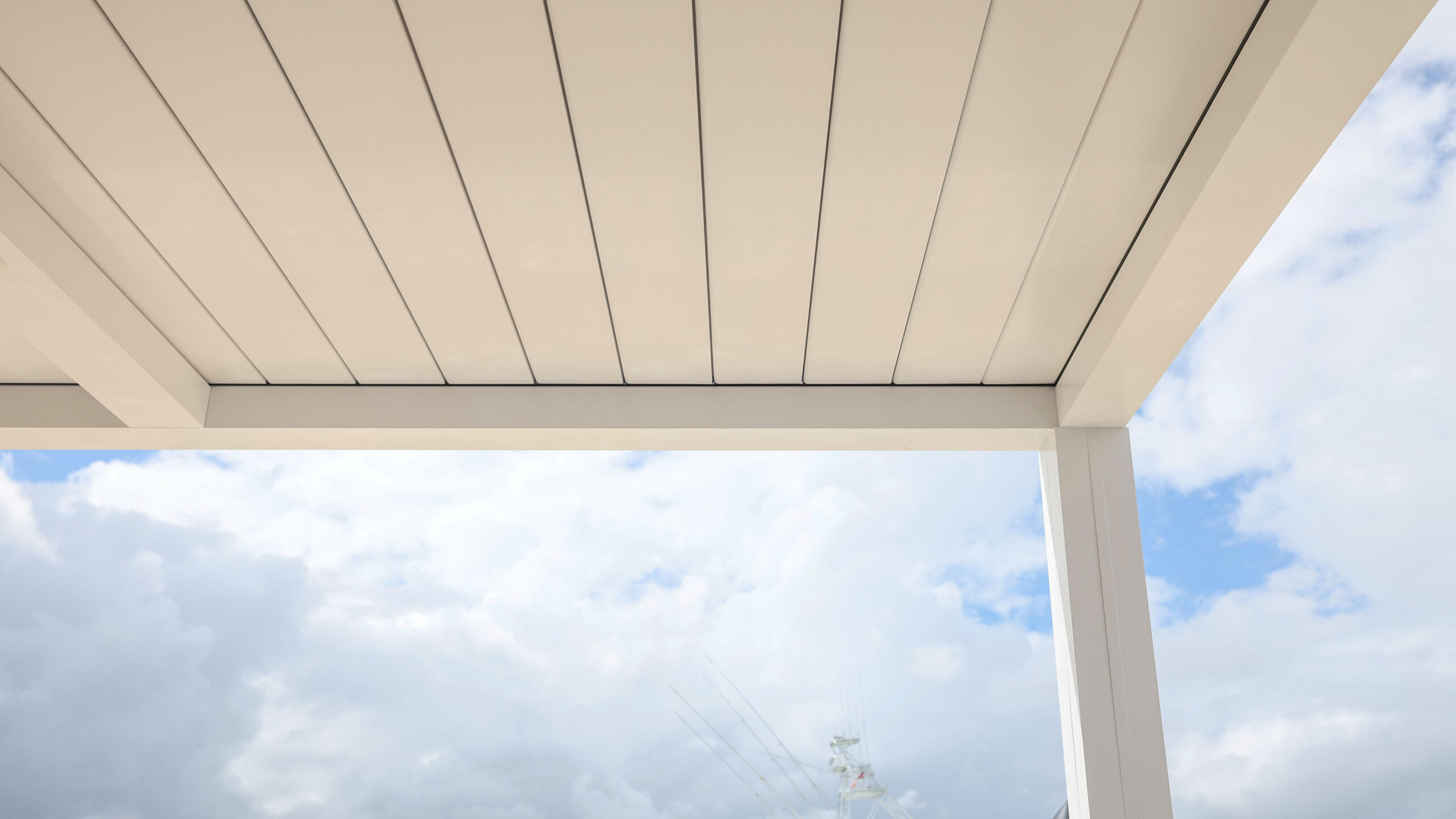
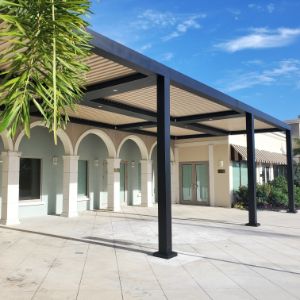
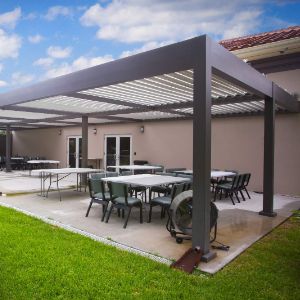
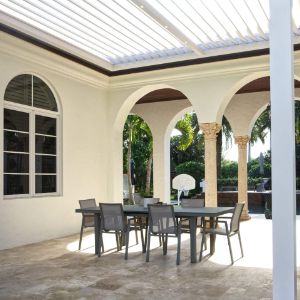
In South Florida, SYZYGY Global brings this legacy to life through every R-Blade, R-Shade, and K-Bana pergola. Each system is built from high-grade 6063-T6 aluminum, a marine-grade alloy prized for its durability, sleek finish, and enduring performance in coastal environments.
Every detail—concealed marine-grade stainless steel hardware, dual-walled gapless louvers, and fully extruded integrated gutters—reflects the artistry of modern engineering. The result is more than shade; it’s a sculptural expression of precision, design, and resilience.
From centuries of discovery to the spaces SYZYGY Global designs today, aluminum’s journey has transformed from raw element to refined architecture—proof that true innovation never loses its luster.
Aluminum’s transformation—from ancient mineral to modern architectural masterpiece—isn’t just a tale of science; it’s a testament to innovation meeting lifestyle. In South Florida, where design must coexist with salt air, humidity, and hurricane-force winds, aluminum isn’t simply preferred—it’s essential.
Its natural balance of strength, lightness, and corrosion resistance makes it the ideal aluminum building material for coastal living. Within that foundation, SYZYGY Global creates pergola systems that embody both endurance and elegance—structures that defy the elements while defining outdoor luxury.
From 19th-century laboratories to 21st-century backyards in Palm Beach, aluminum’s evolution has shaped how we build, protect, and elevate the art of outdoor living.
Disclaimer: Hurricane-rating only applies to the R-Blade motorized louvered pergola. Miami-Dade County, Florida NOA No. 25-0205.04 – Expiration March 20, 2030



























Name